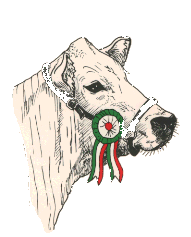
The Marchigiana breed derived from the long-horned cattle that reached Italy in the sixth century AD following the barbarian invasions.
Today, this breed has lost many of its original somatic traits and can be defined as a "synthetic" beef cattle breed created in Italy.
During the second half of the nineteenth century, breeders from the Marches region had Chianina bulls mount their dams in order to improve the beef-production capacity of these work animals. The results were soon evident and not only did muscle development improve, but the coat became lighter, the horns shorter and the head lighter.
In these subjects, known as "short-horns", this capacity improved significantly, but the increase in stature made the oxen unsuitable for working on the hilly and sub- mountain areas of the Marches. Therefore, at the beginning of the twentieth century, widespread cross-breeding with Romagnola bulls was performed in order to decrease stature and improve the structure of the breed. However, following all this cross-breeding, which was done without any precise indications, Marchigiana cattle looked more like a population than a true breed. For this reason, a decision was made in 1932 to stop any type of cross-breeding and to proceed with improving the breed through selection conducted according to directives that entailed listing in herd books.
This breed has succeeded in earning itself an important niche, starting right from its very origins. In fact, the breed has spread from the Marches area throughout all of central Italy, even going as far as the southern regions. As of the Seventies, the Marchigiana breed has also been exported to various countries including the United States, Canada, Brazil, ^Argentina, Great Britain and Australia. Now, countries in northern Europe are also starting to discover the potential offered by this breed, which seems to have gained favor particularly among Dutch breeders.
The evolution of the Marchigiana breed into a beef-cattle type has been progressive and significant. Its stature has been decreased, its transverse diameters have been accentuated to a greater extent, its length has been increased and the legs and head have become lighter. This implies an important increase in yield at slaughter, which can be certified at around 66 - 67% in bullocks. The area of the longissimus dorsi muscle has increased, together with the increased percentage weight of edible parts. Beef quality is excellent, with a rosy color, fine grain and just the right amount of marbling.
Improvement and selection work began on the Marchigiana at the same time as cross- breeding with Chianina and Romagnola bulls was abandoned definitively. Research within the population to find subjects that were best suited for this dual capacity (meat and work), foremost and most recently for the beef-producing capacity, has conditioned the evolution of this breed towards the ultramodern and functional stereotype we are familiar with today. Well-pronounced muscle development, a long trunk, accentuated transverse diameters, fine bone structure and skin, have now become a constant for this breed, making it extremely consistent with market requirements.
Now that the era of share-cropping has come to an end together with the herd sires and farm-run "offspring tests", the breed is now selected according to ANABIC's precepts on the basis of growth capacity, muscle development, estimated slaughter and carcass yield and lastly, typicality.
Breeders are selected through performance tests, whereas females are chosen on the basis of morphology and reproductive efficiency as well as for maternal capacity, or in other words, the cow's ability to raise its young during the lactation phase.
The selection program also envisions the use of planned mating between the best tested bulls and cows that have the highest indices, using modern reproductive technologies to the greatest possible extent.
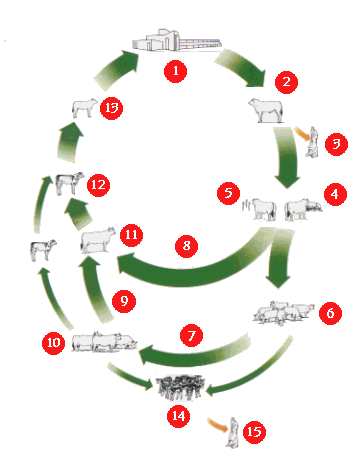 SELECTION GOALS AND SCHEME
The selection diagram summarizes the activities that are carried out in order to ensure genetic improvement. These activities center on a genetic evaluation of the male breeders that are to be assigned to artificial insemination (5) on the basis of performance tests (1). Assessment and choice of breeding cows is based on maternal capacity and reproductive efficiency (8), while mating is aimed towards further accelerating genetic progress. Lastly, offspring are checked for traits that cannot be noted directly through performance tests (14).
Regardless of whether we are talking about bulls or cows, there are three parameters that must be taken into consideration in assessing breeders: productivity, genealogy and morphology.
In beef cattle, where morphology also means function, the morphological evaluation becomes particularly important since it allows us to evaluate the capacity to produce muscle tissue and thus meat.
In the past, far too much importance was given to aesthetic details due to the false assumption that there was a correlation between appearance and function. This inevitably led to formal evaluations that neglected the animal's true morphological and functional value and thus went beyond any logic of selection and genetic improvement.
Consequently, evaluation methods needed to undergo radical changes. The concept of "outer beauty" was replaced with the concept of "functional beauty" that was aimed towards identifying animals with the functional and morphological traits to become excellent breeders according to the selective trends that the Association had set for itself.
The first significant modification was made in 1986 when ANABIC introduced a new morphological evaluation sheet that attributes greater weight to muscle development traits as compared to other trait groups (skeletal structure and breed characteristics).
The definitive turning-point came when the breed standard was revised. With the new standard, in addition to channeling selection towards animals that were closer to market requirements, the following objectives were also pursued:
- maximum emphasis on characteristics related to beef production
- greater tolerance towards "formal" and non-functional morphological characteristics
- elimination of superfluous parts related to general zoognostic concepts
- maximum simplicity of explanation in order to avoid subjective interpretation.
What should immediately be striking about the Marchigiana breed is the length of its trunk, the strength of its transverse diameters and its fine-boned skeletal structure, which is light in relation to its size. Taken as a whole, it should be harmonious, agile in its movements and have a docile temperament.
A large-sized beef cattle breed, the Marchigiana is characterized by the high daily weight increases and adult subjects can achieve a considerable weight, which can easily exceed 1200 kg in bulls and 750 in cows.
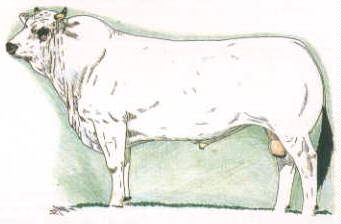
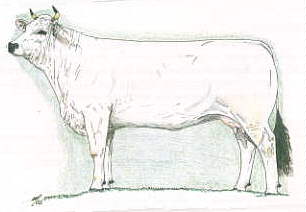
This breed's white coat and pigmented skin ensure its well-known resistance to solar radiation. Hair is white with gray shading on the front quarters, particularly in bulls. Any red hair present on the sinciput does not represent crossbreeding, but indicates the discontinuous expression of genes present in the genetic inheritance of this breed. Calves are wheat-colored at birth and turn white at around three months. Pigmentation is pronounced.
The skin is fine in quality; the dewlap and sheath are light, features that benefit the commercial value of the animal for slaughter and also perform a thermoregulatory function.
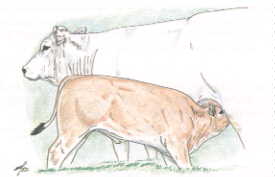
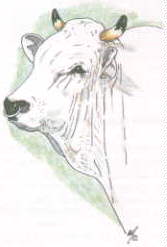
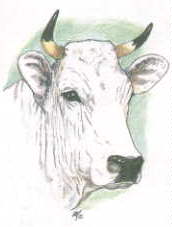
The neck is muscular, with fine cutaneous folds. The bulls have a marked gibbus even at an early age. The dewlap is light.
The shoulder must be wide in order to constitute a broad base for the powerful muscles in this area. Proper adherence to the trunk is ensured by proper tone in the muscles of the thoracic girdle. In addition, proper joint opening between the scapula and the humerus (115°) will ensure good motor function.
Even though the withers supply third-quality cuts, they must be broad and muscular and joined harmoniously to the neck. back and shoulders. This type of structure is indicative of abundant transverse diameters and adequate muscle development.
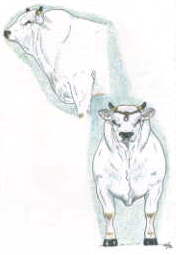
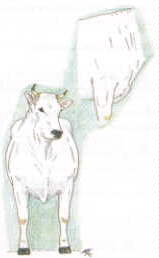
Due to the fundamental importance of the cuts of meat supplied by this area, which help determine carcass value, this area must present marked muscle development, demonstrating a "double convexity". This feature is determined mainly by the longissimus dorsi (the largest and longest even muscle on the body), which supplies cuts that are rich in muscle tissue but low on connective tissue (steaks).
In addition to the longissimus dorsi, this region includes other sublombar muscles that constitute noble cuts such as filet and sirloin. The loins must be extremely muscular, long and full, demonstrating the "double-convexity", also seen in the back, that is typical of specialized beef-cattle breeds. The lumbodorsal line must be straight and strong, denoting a suitable indication of bone structure.
Chest breadth is synonymous with thoracic cavity capacity and thus of proper function as far as the organs it contains are concerned. It must be muscular, sloping and convex.
The skeletal base of this area must ensure the development and function of the organs and body parts located in the thoracic cavity. The sides must be arched and covered well by the muscle layer. The thorax represents an important index of constitutional strength.
Although the abdomen is broad and ensures good ingestive capacity, it must be well supported. The lower line must be practically straight, a feature typical of beef cattle with high yields at slaughter. This is an indication of good muscle tone in this area.
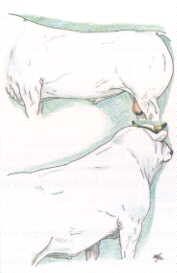
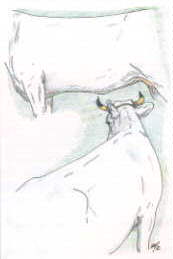
The rump, which should be as broad as possible, must offer an adequate support base for the muscles, particularly the gluteal muscles that supply top-quality cuts. Moreover, rump width is an indication of reproductive function, especially as far as easy calving is concerned.
A slight front to back inclination of the rump also ensures proper elimination of urine and of post-partum lochia, facilitating calving as well. The insertion point of the tail must be clean and regular and represent a harmonious continuance of the upper profile of the rump.
Given the importance of these areas in producing noble cuts of beef, both of these areas must naturally present an accentuated development of the muscle mass, which is also a decisive aspect in determining the value of the animal for slaughter.
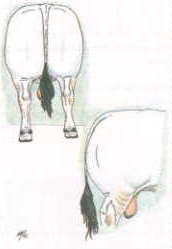
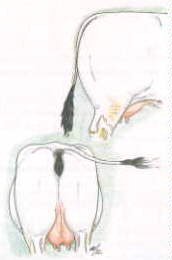
FORELEGS - Proper perpendicularity, muscular arms and forearms; solid and light shin.
The forelegs must be perfectly perpendicular and must be set on strong solid hooves, showing solid and sharp joints. The shin must be fine-boned.
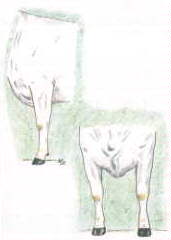
HIND LEGS - Proper perpendicularity, very muscular leg, lean strong hocks, solid and light shin.
Since these parts are a determining factor in relation to duration of the animal's productive career, they must be strong and have proper perpendicularity, with clean and strong joints set at a proper angle. Tendons must be well evident. The shins must be lean and light.
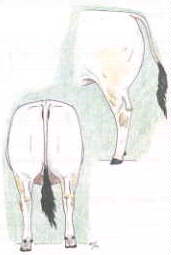
FEET - Strong, very compact, with heels set high.
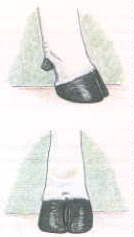
The foot also helps determine the duration of the animal's career. It must be strong and very compact, and the heel must also be high. The pastern must be solid and properly angled.
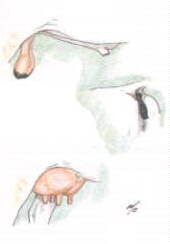
This organ must ensure the cow's capacity to produce calves that will be heavy when weaned. Therefore, it is important that the cow produce a large amount of milk. Moreover, the udder must be shaped to facilitate sucking by the calf, particularly during the first few days after birth, a phase during which the size and shape of the teats play a fundamental role.
The shape, size and symmetry of the testicles ensure reproductive efficiency. The presence of testicular hypoplasia, monorchism or cryptorchism, or any other alterations in testicular shape mean that the subjects are not suitable for reproduction.
|
Height of withers
|
||||
|
Class
|
Heifers18-24 Months
|
Cows 1st calving
|
Multiparae
|
Males 12 Months
|
|
1
|
<127
|
<135
|
<139
|
<127
|
|
2
|
127-131
|
135-139
|
139-143
|
127-130
|
|
3
|
132-136
|
140-144
|
144-148
|
131-134
|
|
4
|
137-141
|
145-149
|
149-153
|
135-138
|
|
5
|
>141
|
>149
|
>153
|
>138
|
|
Length of Trunk
|
||||
|
Class
|
Heifers18-24 Months
|
Cows 1st calving
|
Multiparae
|
Males 12 Months
|
|
1
|
<137
|
<149
|
<158
|
<137
|
|
2
|
137-144
|
149-155
|
158-163
|
137-142
|
|
3
|
145-152
|
156-162
|
164-169
|
143-148
|
|
4
|
153-160
|
163-169
|
170-175
|
149-154
|
|
5
|
>160
|
>169
|
>175
|
>154
|
|
Height of Thorax
|
||||
|
Class
|
Heifers18-24 Months
|
Cows 1st calving
|
Multiparae
|
Males 12 Months
|
|
1
|
<60
|
<66
|
<67
|
<61
|
|
2
|
60-63
|
66-68
|
67-70
|
61-63
|
|
3
|
64-67
|
69-71
|
71-74
|
64-66
|
|
4
|
68-71
|
72-74
|
75-78
|
67-69
|
|
5
|
>71
|
>74
|
>78
|
>69
|
|
Width of Thorax
|
||||
|
Class
|
Heifers18-24 Months
|
Cows 1st calving
|
Multiparae
|
Males 12 Months
|
|
1
|
<42
|
<43
|
<45
|
<43
|
|
2
|
42-46
|
43-47
|
45-49
|
43-44
|
|
3
|
47-51
|
48-52
|
50-54
|
45-46
|
|
4
|
52-56
|
53-57
|
55-59
|
47-48
|
|
5
|
>56
|
>57
|
>59
|
>48
|
|
Width of Lips
|
||||
|
Class
|
Heifers18-24 Months
|
Cows 1st calving
|
Multiparae
|
Males 12 Months
|
|
1
|
<46
|
<47
|
<52
|
<42
|
|
2
|
46-48
|
47-51
|
52-55
|
42-43
|
|
3
|
49-51
|
52-56
|
56-59
|
44-45
|
|
4
|
52-54
|
57-61
|
60-63
|
46-47
|
|
5
|
>54
|
>61
|
>63
|
>47
|
|
Width of Pins
|
||||
|
Class
|
Heifers18-24 Months
|
Cows 1st calving
|
Multiparae
|
Males 12 Months
|
|
1
|
<30
|
<30
|
<31
|
<30
|
|
2
|
30-32
|
30-32
|
31-33
|
30-31
|
|
3
|
33-35
|
33-35
|
34-36
|
32-33
|
|
4
|
36-38
|
36-38
|
37-39
|
34-35
|
|
5
|
>38
|
>38
|
>39
|
>35
|
|
Length of Rump
|
||||
|
Class
|
Heifers18-24 Months
|
Cows 1st calving
|
Multiparae
|
Males 12 Months
|
|
1
|
<43
|
<50
|
<52
|
<47
|
|
2
|
43-46
|
50-52
|
52-54
|
47-48
|
|
3
|
47-50
|
53-55
|
55-57
|
49-50
|
|
4
|
51-54
|
56-58
|
58-60
|
51-52
|
|
5
|
>54
|
>58
|
>60
|
>52
|